Work life balance wheel: check where your time goes
A work life balance wheel is a chart that rates eight parts of your week, from workload and boundaries to sleep, family time and hobbies, on a scale of 1 to 10. When one slice sinks far below the others, work is taking time from that area. Fill in the wheel below in two minutes.
By The Evenspoke team (Product and testing). Last updated .
Download the blank work-life balance wheel template (PDF, US Letter)
- 5
- 5
- 5
- 5
- 5
- 5
- 5
- 5
- Balance
- 100/100
- Average
- 5
- Lowest
- Workload (5)
- Spread
- 0
Turn the wheel into a one week plan
How to use the work life balance wheel, step by step
- Think about your last two working weeks, not your best week.
- Score workload, boundaries, sleep, exercise, family time, friends, hobbies and time alone.
- Mark a goal for the two areas that feel most squeezed.
- Pick one boundary you can set this week, such as a fixed end time.
- Save or download the wheel and repeat the check on the same day next month.
The wheel, the PNG and the PDF are free with no limit. The first 3 action plans each day are free too. After that, see the pricing page for packs and plans, or read how we test the tool.
Work life balance wheel tested with a real wheel
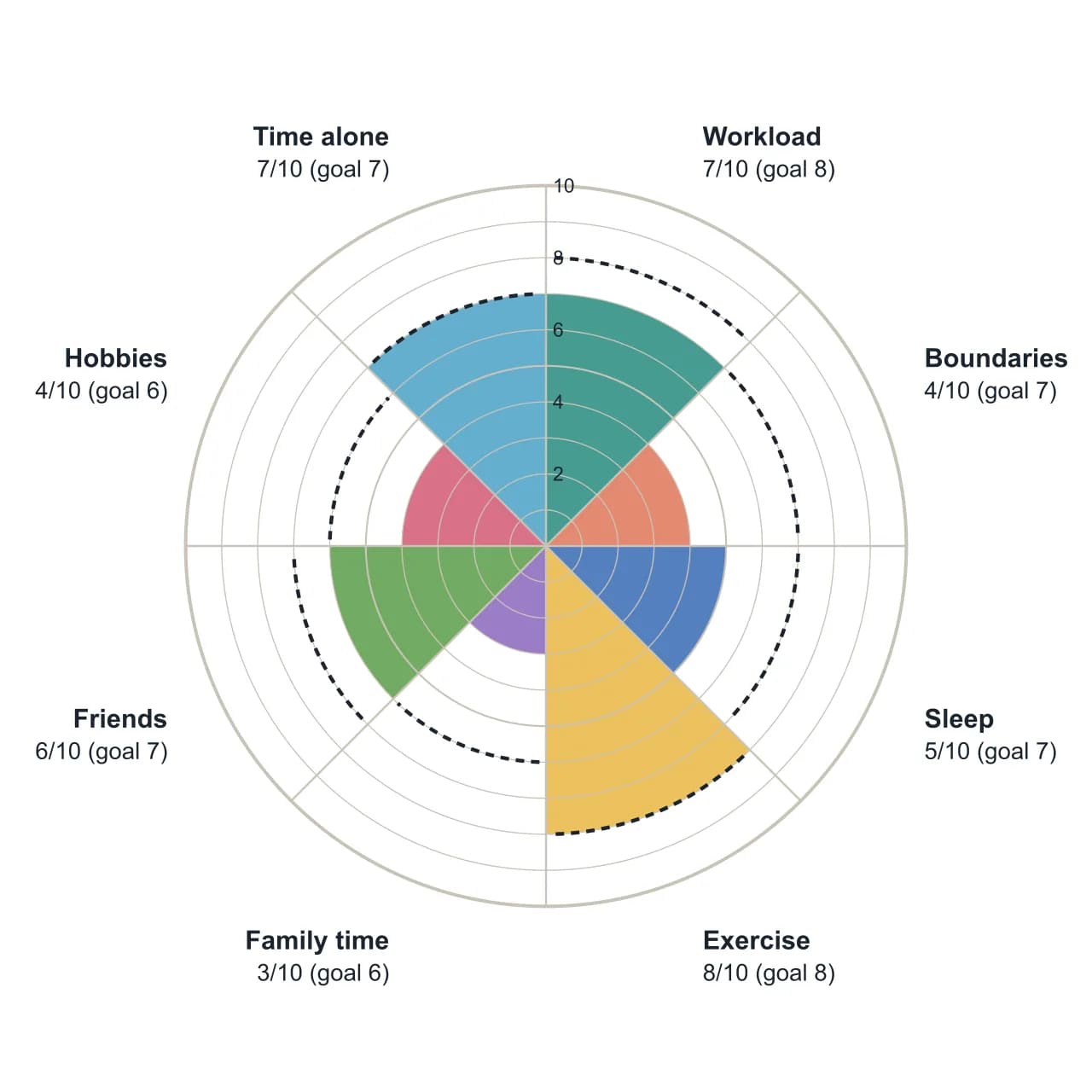
We scored a test wheel with this exact tool. Therefore, the chart, the numbers and the first plan step all come from the same run, so you can compare them with your own result.
- Test input
- Work-life balance wheel: Workload 7, Boundaries 4, Sleep 5, Exercise 8, Family time 3, Friends 6, Hobbies 4, Time alone 7
- Output
- Wheel chart, balance score and a one week plan
- Balance score
- 63 of 100
- Average
- 5.5
- Lowest area
- Family time (3)
- Plan focus
- Family time, Boundaries, Hobbies
- First step
- Send one message to a family member you have not spoken to in a while. Keep it short and warm.
- Output size
- 58 KB
- Processing time
- 1 ms
How we test: every page scores its own area set with the same fixed test scores, and we check each wheel by hand. More on the about page.
The eight areas of this work life balance wheel
The wheel opens with two work areas and six life areas. Workload asks if the amount of work fits the hours you have. Boundaries asks how often work spills into evenings, weekends or holidays.
The other six slices show what work can crowd out. Sleep and exercise cover your body, while family time and friends cover the people close to you. Hobbies and time alone cover the rest you need to recover. Because every area is on one chart, you see the trade offs at a glance.
Signs your balance is off
A low score in boundaries next to a low score in sleep is the most common pattern. It often means work follows you home, so rest never quite starts. Another sign is a high workload score paired with low scores in friends and hobbies.
Also watch for small daily clues. For example, you check email in bed, cancel plans more than you keep them, or feel tired on Monday morning. None of these proves a problem on its own. Still, if three or more show up, the wheel will usually reflect it.
Setting boundaries that hold
Start with one rule you control, since a rule you need permission for tends to fade. A fixed end time, no work apps on the phone after dinner, or one evening a week with no screens are all good first steps.
Then tell the people who need to know. A short note to your manager or clients works better than a silent change. Finally, give the rule four weeks before you judge it, because habits take time to settle.
A monthly routine with the wheel
Fill in the work life balance wheel on the same day each month, such as the first Monday. Save it to a free account to see the history, or download the PNG and keep the files in one folder.
Compare only two things: the lowest area and the spread. If the lowest area rose by two points, the change worked. If not, try a different boundary next month. Meanwhile, the one week action plan can suggest three small steps for the areas with the largest gap.
This is not a burnout test
The wheel is a reflection exercise, not a clinical or diagnostic tool. It cannot tell you whether you have burnout, depression or an anxiety disorder.
However, it can show that something needs attention. If you feel exhausted most days, dread work and feel less able to do your job for weeks at a time, talk to a doctor, a counselor or your employee assistance program.
Work life balance wheel at a glance
| Item | Detail |
|---|---|
| Areas | workload, boundaries, sleep, exercise, family time, friends, hobbies, time alone |
| Scale | 1 to 10 per area, optional goal |
| Best rhythm | once a month, on the same day |
| Time | about 2 minutes |
| Output | wheel chart, balance score, PNG, PDF report, share link |
| Limits | reflection only, not a burnout diagnosis |
Work life balance wheel FAQ
What is a work life balance wheel?
It is a version of the wheel of life built around work and recovery. You score eight areas of your week, and the shape shows where work takes more than its share.
What areas are in a work life balance wheel?
This one uses workload, boundaries, sleep, exercise, family time, friends, hobbies and time alone. You can rename areas or add up to 12 in total.
How often should I check my work life balance?
Once a month is enough for most people. Weekly checks tend to follow your mood more than real change.
Can my team use the work life balance wheel?
Yes, as a private check in. Each person fills in their own wheel, then the team talks about patterns without sharing personal scores.
Does a low score mean I have burnout?
No. The wheel does not diagnose burnout. If exhaustion and low mood last for weeks, see a doctor or a licensed counselor.
Is there a printable work life balance wheel?
Yes. The printable link at the top of the page opens a free blank PDF with the same eight areas, sized for US Letter.