Free career wheel
A career wheel rates eight parts of your working life from 1 to 10: pay and benefits, meaningful work, skills and learning, manager and team, growth path, autonomy, work-life fit and workplace. The shape shows what to fix in your current job and what to look for in the next one.
By The Evenspoke team (Product and testing). Last updated .
Download the blank career wheel template (PDF, US Letter)
- 5
- 5
- 5
- 5
- 5
- 5
- 5
- 5
- Balance
- 100/100
- Average
- 5
- Lowest
- Pay and benefits (5)
- Spread
- 0
Turn the wheel into a one week plan
How to fill in the career wheel, step by step
- Think about your current job as it is this month, not as it was when you started.
- Score each of the eight career areas from 1 to 10.
- Turn on goals and set the score each area needs to reach for you to stay.
- Note the two areas with the largest gap between score and goal.
- Download the PDF and bring it to your next review or career talk.
The wheel, the PNG and the PDF are free with no limit. The first 3 action plans each day are free too. After that, see the pricing page for packs and plans, or read how we test the tool.
Career wheel tested with a real wheel
We scored a test wheel with this exact tool. Therefore, the chart, the numbers and the first plan step all come from the same run, so you can compare them with your own result.
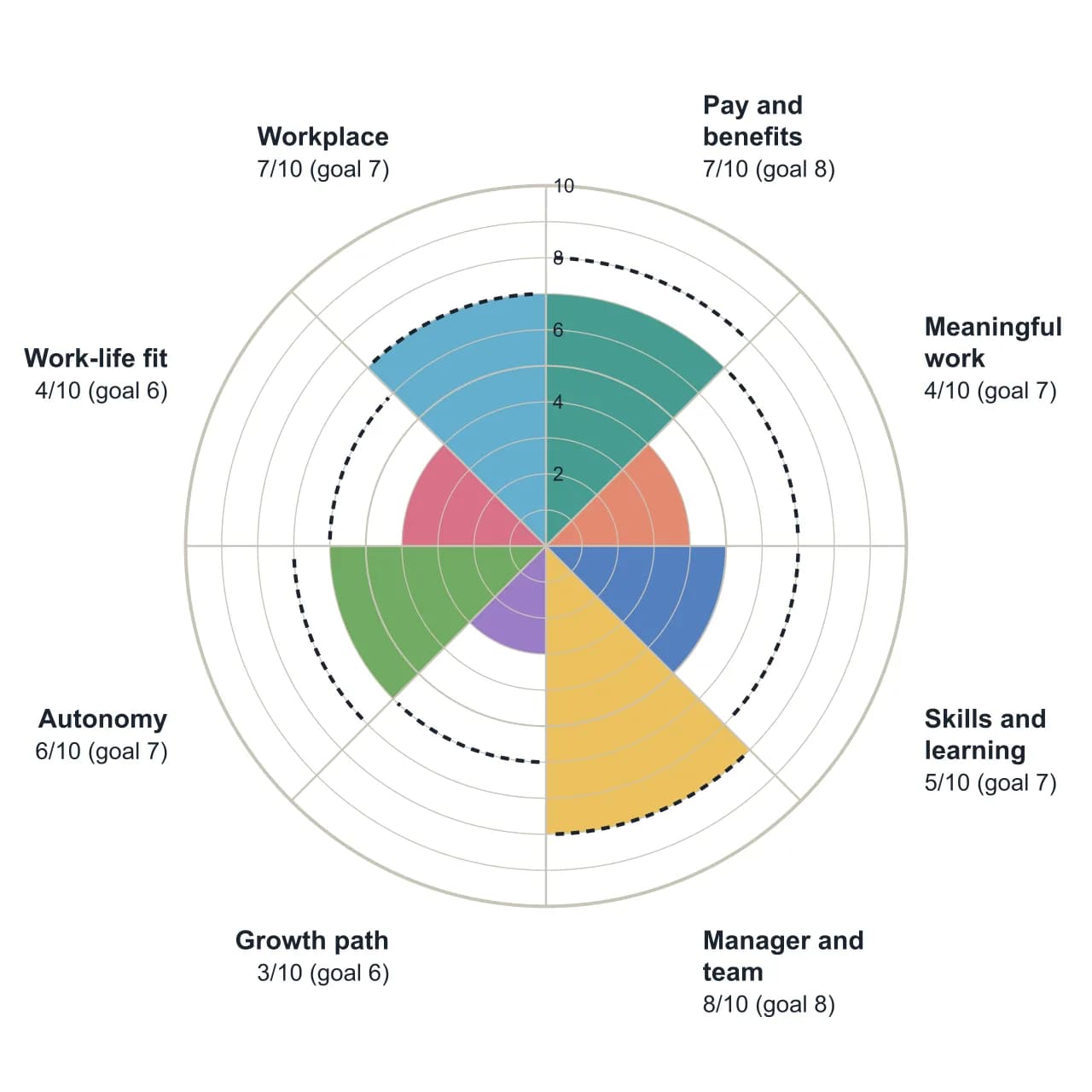
- Test input
- Career wheel: Pay and benefits 7, Meaningful work 4, Skills and learning 5, Manager and team 8, Growth path 3, Autonomy 6, Work-life fit 4, Workplace 7
- Output
- Wheel chart, balance score and a one week plan
- Balance score
- 63 of 100
- Average
- 5.5
- Lowest area
- Growth path (3)
- Plan focus
- Growth path, Meaningful work, Work-life fit
- First step
- Choose one book, course or podcast series on a topic you care about and give it 20 minutes three times this week.
- Output size
- 63 KB
- Processing time
- 1 ms
How we test: every page scores its own area set with the same fixed test scores, and we check each wheel by hand. More on the about page.
The eight areas of the career wheel
Pay and benefits asks whether your pay feels fair for the work. Meaningful work asks whether the tasks matter to you. Skills and learning covers what you pick up on the job, while growth path asks whether you can see a next step inside the company.
Manager and team is about trust and support from the people you work with every day. Autonomy measures how much say you have over how you do your work. Work-life fit covers hours, evenings and weekends. Finally, workplace means the office, the remote setup and the tools you use.
Together these areas split a job into parts you can judge one at a time. As a result, "I hate my job" often turns into "my manager scores a 3, but the work itself is a 7."
When to use it: job change, review or burnout check
Before a job change, score your current job first. Then score each offer on the same eight areas. For example, a raise that comes with a 2 in autonomy may not be the step up it looks like on paper.
Before a performance review, the wheel gives you a calm way to raise issues. Instead of a list of complaints, you can say which two areas you want to improve and ask what would help.
It also works as a quick burnout check. Low work-life fit next to low meaningful work is a pattern worth taking seriously. Even so, the wheel is a reflection exercise, not a clinical test, so talk to a doctor if exhaustion lasts for weeks.
Reading your result
Start with the lowest slice, but also ask whether you can change it where you are. Pay, manager and workplace can often move inside the same company. In contrast, a low score in meaningful work is harder to fix without a new role.
Next, look at the balance score under the wheel. A score near 100 means the areas are even. A low balance score with a high average usually points to one sore spot in an otherwise good job.
Then compare over time. Save the wheel to a free account, score again after three months, and see whether the changes you asked for actually happened.
Using it with a coach or manager
Career coaches often ask clients to fill in the wheel before the first session. Because the scores sit on one page, the talk can start with the two weakest areas instead of the whole story.
Managers can use it in one-to-one meetings too. However, it works only when the employee feels safe giving a low score, so share it as an invitation, not a form.
Career wheel at a glance
| Item | Detail |
|---|---|
| Areas | 8 career areas, from pay to workplace |
| Scale | 1 to 10 per area, with an optional goal |
| Best for | job changes, performance reviews, burnout checks |
| Results | career wheel chart, balance score, lowest area |
| Printable | blank US Letter PDF of the career wheel |
| Cost | free, no account needed |
Career wheel FAQ
What is a career wheel?
A career wheel is a circle chart that rates eight parts of your job, such as pay, autonomy and growth path, from 1 to 10.
What are the areas of a career wheel?
This career wheel uses pay and benefits, meaningful work, skills and learning, manager and team, growth path, autonomy, work-life fit and workplace. You can rename any of them.
How do I use a career wheel to compare job offers?
Score your current job first, then score each offer on the same areas. Compare the lowest areas, not just the pay.
Can a career wheel show burnout?
It can show warning signs, such as low work-life fit and low meaningful work together. It is not a diagnosis, so see a doctor if exhaustion lasts.
Is there a printable career wheel PDF?
Yes. Use the printable link on this page for a blank US Letter career wheel you can fill in by hand.
How often should I do a career wheel?
Every three to six months, and before any review or job decision.