Wheel of life categories explained
The classic wheel of life categories are career, money, health, family and friends, romance, personal growth, fun and recreation, and physical environment. Many coaches add purpose, community or rest. Pick 8 to 10 areas that cover your whole week, and rename any that do not fit your life.
By The Evenspoke team (Product and testing). Last updated .
- 5
- 5
- 5
- 5
- 5
- 5
- 5
- 5
- 5
- 5
- Balance
- 100/100
- Average
- 5
- Lowest
- Career (5)
- Spread
- 0
Turn the wheel into a one week plan
How to pick your own wheel of life categories, step by step
- Start with the eight classic areas and read each one out loud.
- Cross out any area that plays no part in your life right now.
- Add one area you think about every week but cannot see on the wheel.
- Merge or split areas until you have 8 to 10 in total.
- Score each area from 1 to 10 and check that no big part of life is missing.
The wheel, the PNG and the PDF are free with no limit. The first 3 action plans each day are free too. After that, see the pricing page for packs and plans, or read how we test the tool.
Wheel of life categories tested with a real wheel
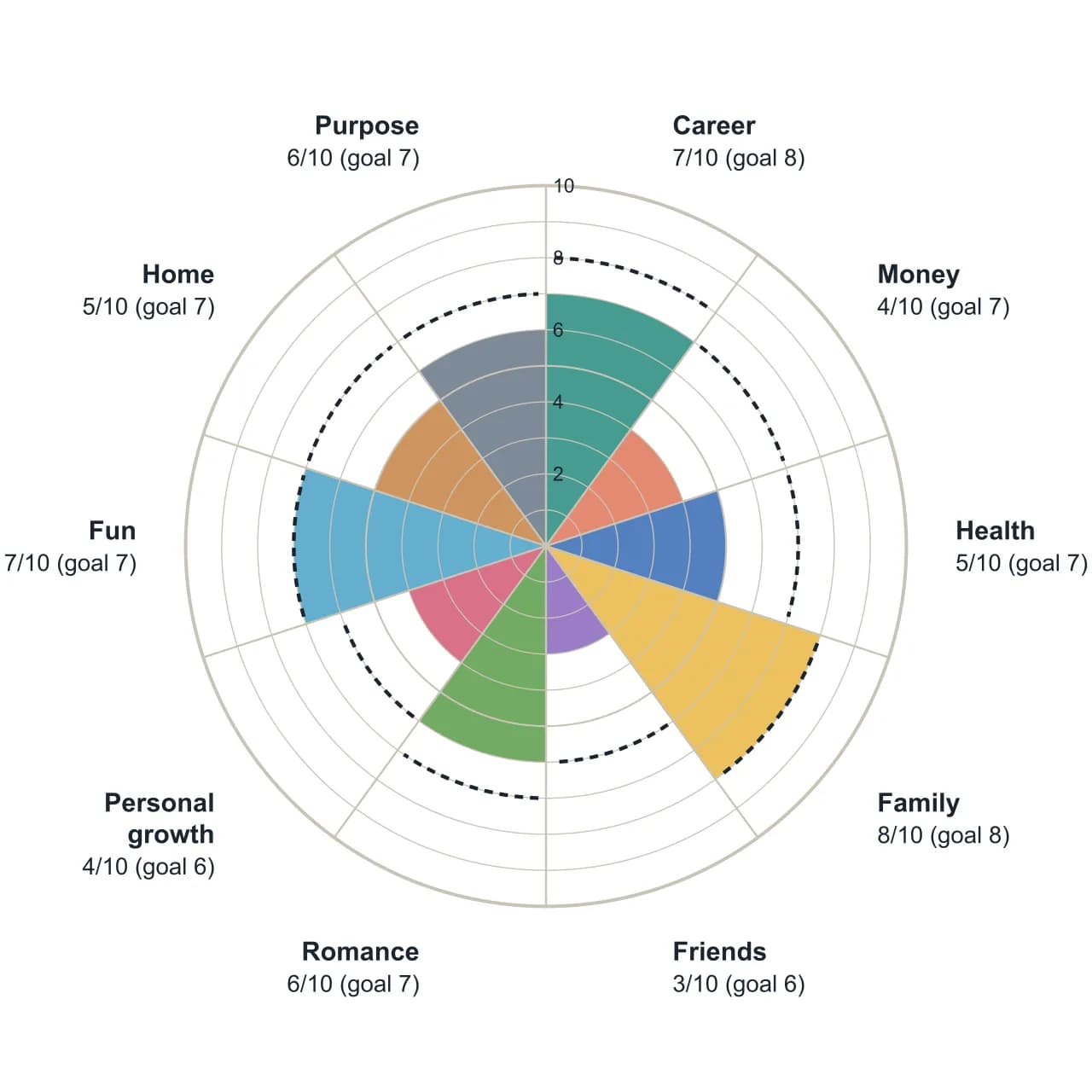
We scored a test wheel with this exact tool. Therefore, the chart, the numbers and the first plan step all come from the same run, so you can compare them with your own result.
- Test input
- Coaching 10 areas: Career 7, Money 4, Health 5, Family 8, Friends 3, Romance 6, Personal growth 4, Fun 7, Home 5, Purpose 6
- Output
- Wheel chart, balance score and a one week plan
- Balance score
- 67 of 100
- Average
- 5.5
- Lowest area
- Friends (3)
- Plan focus
- Friends, Money, Personal growth
- First step
- Text two friends today. Ask a real question, not just a check in.
- Output size
- 63 KB
- Processing time
- 1 ms
How we test: every page scores its own area set with the same fixed test scores, and we check each wheel by hand. More on the about page.
The classic wheel of life categories, one by one
Career covers your job, studies or main daily work. A 3 means you dread Mondays or feel stuck. An 8 means the work fits you, even if some days are hard. Money is about how safe you feel with it, not how much you earn. So a 3 is lying awake over bills, while an 8 is paying them with room to save.
Health includes sleep, food, movement and energy. For example, a 3 might be tired every afternoon with no exercise. An 8 is feeling strong most days. Family and friends is about closeness and support. A 3 feels lonely or tense at home, whereas an 8 means you have people you can call at midnight.
Romance, growth, fun and environment
Romance covers a partner, or dating if you are single. A 3 might be a cold or tense relationship. An 8 feels warm and close most of the time. Personal growth means learning and becoming who you want to be. Here a 3 feels like standing still, while an 8 means you are learning something you care about.
Fun and recreation is time you enjoy for its own sake. A 3 means you cannot remember the last free evening, but an 8 means hobbies and play happen each week. Physical environment is your home, desk and neighborhood. In that area, a 3 is a cluttered space that drains you, and an 8 is a place you like coming back to.
Other categories coaches add to the wheel of life
Purpose asks whether your days point somewhere that matters to you. Community covers neighbors, volunteering and groups you belong to. Spirituality can mean faith, but it can also mean nature, meditation or a sense of meaning. Rest is often split off from fun, because a busy hobby is not the same as real downtime.
Some wheels also split health into physical and mental health, or family into family and friends. In fact, the wellness wheel used in many health programs has its own set of eight dimensions, from emotional to environmental.
How to choose 8 to 10 wheel of life categories
Fewer than 8 areas hide too much. On the other hand, more than 10 turns the wheel into a long survey. First, keep the areas you would miss if they vanished. Next, add an area only when it would change a decision you make this month.
Also, make each name clear enough to score in one breath. For instance, "Life" is too wide, but "Friends I see in person" is easy to rate. You can rename, add or remove areas on the wheel above, from 4 up to 12.
Wheel of life categories at a glance
| Category | What a high score looks like |
|---|---|
| Career | work that fits you most days |
| Money | bills paid with room to save |
| Health | good sleep, regular movement, steady energy |
| Family and friends | people you can lean on |
| Personal growth | learning something you care about |
| Purpose (optional) | days that point toward what matters to you |
Wheel of life categories FAQ
What are the 8 categories of the wheel of life?
Career, money, health, family and friends, romance, personal growth, fun and recreation, and physical environment. This is the set most coaches start with.
Can I change the categories on the wheel of life?
Yes. The wheel is yours, so rename, add or remove areas. This tool lets you use 4 to 12 areas and switch between ready-made sets.
How many categories should a wheel of life have?
Most people use 8 to 10. Fewer hides important parts of life, and more makes each score harder to think about.
Is spirituality a wheel of life category?
It is a common extra area. Some people call it purpose or meaning instead, so it fits both religious and non-religious users.
What is the difference between the wheel of life and the wellness wheel?
The wheel of life uses everyday areas like career and romance. The wellness wheel uses eight dimensions of wellness, such as emotional, intellectual and spiritual.
Should family and friends be separate categories?
Split them if one is going well and the other is not. Otherwise a single area keeps the wheel shorter.