What is the wheel of life?
The wheel of life is a circle chart that shows what your life looks like across about eight areas, such as career, health and relationships. You rate each area from 1 to 10 and join the dots. The shape shows at a glance which parts of your life feel full and which feel thin.
By The Evenspoke team (Product and testing). Last updated .
- 5
- 5
- 5
- 5
- 5
- 5
- 5
- 5
- Balance
- 100/100
- Average
- 5
- Lowest
- Career (5)
- Spread
- 0
Turn the wheel into a one week plan
How to try the wheel of life in five minutes, step by step
- Look at the eight areas on the wheel and rename any that feel wrong for you.
- Give each area a score from 1 to 10 for how it feels this week.
- Watch the wheel fill in and find the shortest slice.
- Pick one area you want to raise over the next month.
- Save or download the wheel so you can compare it later.
The wheel, the PNG and the PDF are free with no limit. The first 3 action plans each day are free too. After that, see the pricing page for packs and plans, or read how we test the tool.
What is the wheel of life tested with a real wheel
We scored a test wheel with this exact tool. Therefore, the chart, the numbers and the first plan step all come from the same run, so you can compare them with your own result.
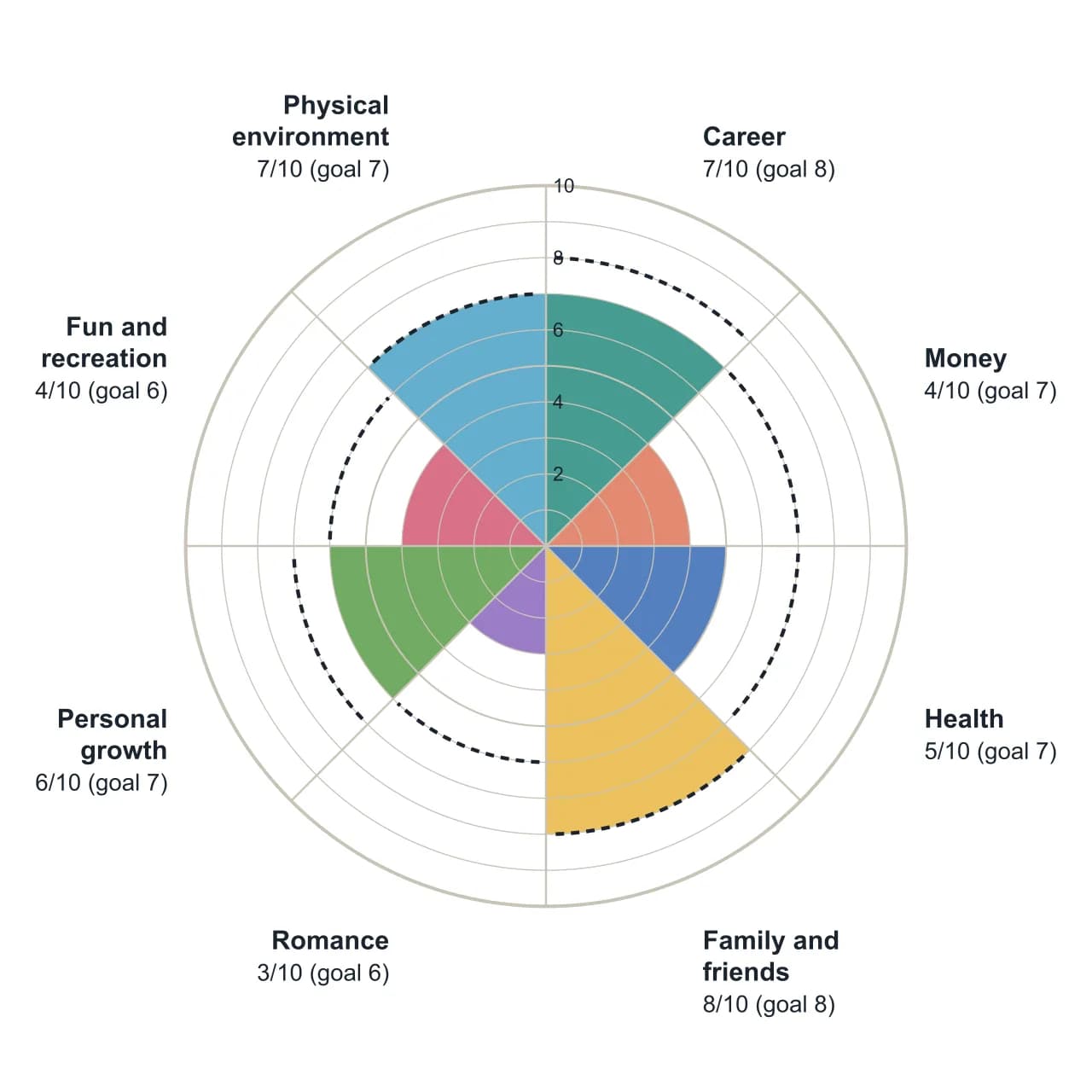
- Test input
- Classic 8 areas: Career 7, Money 4, Health 5, Family and friends 8, Romance 3, Personal growth 6, Fun and recreation 4, Physical environment 7
- Output
- Wheel chart, balance score and a one week plan
- Balance score
- 63 of 100
- Average
- 5.5
- Lowest area
- Romance (3)
- Plan focus
- Romance, Money, Fun and recreation
- First step
- If you have a partner, plan one hour this week with phones in another room. If you are single, write what you want in a partner and what you offer.
- Output size
- 61 KB
- Processing time
- 1 ms
How we test: every page scores its own area set with the same fixed test scores, and we check each wheel by hand. More on the about page.
What the wheel of life is, in plain words
Picture a bicycle wheel cut into slices like a pie. Each slice is one area of your life, and the center of the circle counts as 0. The outer rim counts as 10. You shade each slice up to the score you give it, so a full slice means you feel fully satisfied there.
When you finish, the colored part of the wheel is rarely round. Instead, it has bumps and dents. That uneven outline is the whole point, because it shows the balance of your life as a shape rather than a list of numbers.
In short, the wheel of life is a self-rating tool. It measures how you feel about each area today, not how well you perform by some outside standard.
Where the idea came from: Paul J. Meyer
The tool is usually credited to Paul J. Meyer. He was an American businessman who founded the Success Motivation Institute and wrote programs on goal setting. In the 1960s he used a circle split into life areas to help people set goals in more than one part of life at once.
His point was simple. Success in one area does not make up for neglect in the others. Later, life coaches picked up the circle, and today it is one of the first exercises many of them use with a new client.
Why coaches use the wheel of life and what it shows
Most people arrive at coaching with a vague feeling that something is off. The wheel turns that feeling into a picture in a few minutes. As a result, the coach and the client can talk about a real 4 in health instead of a general sense of being tired.
It also helps the client choose. Rather than trying to fix everything, you pick one or two slices and set a small goal for each. Then, a month later, a second wheel shows what moved and what did not.
What the wheel of life is not, and its limits
The name can be confusing. In Buddhism, the wheel of life (the bhavacakra) is a painting of the cycle of birth, death and rebirth. That symbol has a spiritual meaning and has nothing to do with this coaching chart.
The coaching wheel is also not a clinical test. It cannot diagnose depression, anxiety or burnout, and the scores are not comparable between people. After all, your 6 and a friend's 6 may mean very different things.
Finally, the scores depend on your mood that day. For this reason, one wheel is a snapshot. It becomes useful when you repeat it and look at the trend.
What the wheel of life is, in short
| Question | Answer |
|---|---|
| What it is | a circle chart that rates life areas from 1 to 10 |
| Popularized by | Paul J. Meyer, Success Motivation Institute, 1960s |
| Usual areas | 8, such as career, money, health and romance |
| Who uses it | life coaches, therapists in planning sessions, individuals |
| What it shows | balance between areas, not performance |
| What it is not | a clinical test or the Buddhist bhavacakra |
What is the wheel of life FAQ
What is the purpose of the wheel of life?
It helps you see which areas of your life feel satisfying and which need attention, so you can choose where to set your next goal.
Who created the wheel of life?
Paul J. Meyer, founder of the Success Motivation Institute, is credited with popularizing it in the 1960s as a goal setting tool.
What are the 8 areas of the wheel of life?
A common set is career, money, health, family and friends, romance, personal growth, fun and recreation, and physical environment. You can rename them to fit your life.
Is the wheel of life the same as the Buddhist wheel of life?
No. The Buddhist bhavacakra shows the cycle of rebirth. The coaching wheel is a modern self-rating chart with no religious meaning.
Is the wheel of life a psychological test?
No. It is a reflection exercise. It does not diagnose anything, and low scores are a prompt to think, not a result to worry about.
How often should you do the wheel of life?
Once a month or once a quarter works well. Repeating it shows whether the changes you made are working.