Free wheel of life assessment
To take a wheel of life assessment, rate each of eight life areas from 1 to 10 by how satisfied you feel today. The wheel on this page draws your scores as you move the sliders. Then read the shape: the shortest slice is the area to work on first. It takes about two minutes.
By The Evenspoke team (Product and testing). Last updated .
- 5
- 5
- 5
- 5
- 5
- 5
- 5
- 5
- Balance
- 100/100
- Average
- 5
- Lowest
- Career (5)
- Spread
- 0
Turn the wheel into a one week plan
How to take the wheel of life assessment, step by step
- Read the eight areas and rename any that do not fit your life.
- Move each slider to a score from 1 (very unhappy) to 10 (fully satisfied) for today, not for a good day.
- Turn on goals if you want, and set the score each area should reach in 90 days.
- Look at the shape of the wheel and note the lowest slice and the largest gap to a goal.
- Download the wheel as a PNG or PDF, or save it to your account to compare next month.
The wheel, the PNG and the PDF are free with no limit. The first 3 action plans each day are free too. After that, see the pricing page for packs and plans, or read how we test the tool.
Wheel of life assessment tested with a real wheel
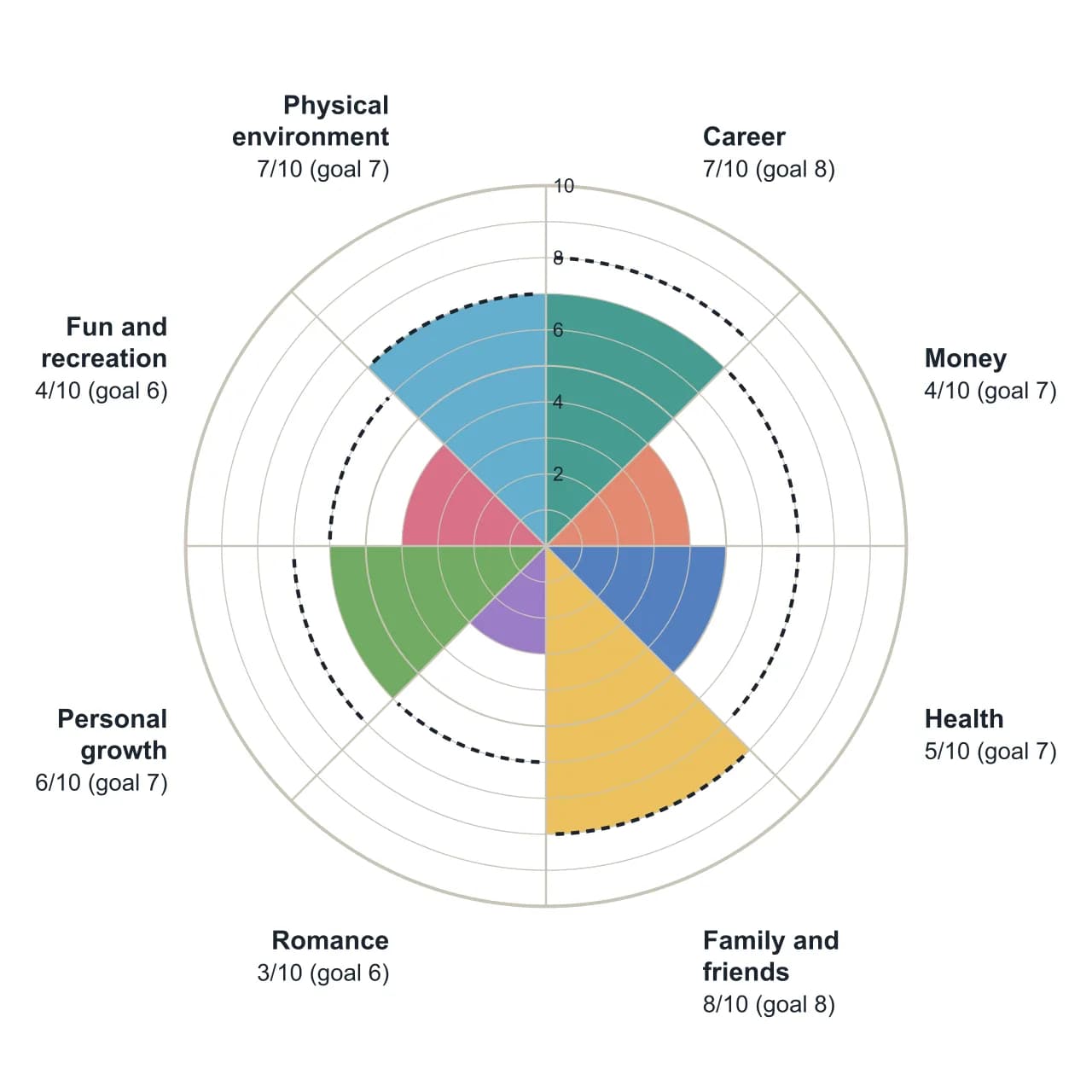
We scored a test wheel with this exact tool. Therefore, the chart, the numbers and the first plan step all come from the same run, so you can compare them with your own result.
- Test input
- Classic 8 areas: Career 7, Money 4, Health 5, Family and friends 8, Romance 3, Personal growth 6, Fun and recreation 4, Physical environment 7
- Output
- Wheel chart, balance score and a one week plan
- Balance score
- 63 of 100
- Average
- 5.5
- Lowest area
- Romance (3)
- Plan focus
- Romance, Money, Fun and recreation
- First step
- If you have a partner, plan one hour this week with phones in another room. If you are single, write what you want in a partner and what you offer.
- Output size
- 61 KB
- Processing time
- 2 ms
How we test: every page scores its own area set with the same fixed test scores, and we check each wheel by hand. More on the about page.
What the wheel of life assessment measures
The assessment measures satisfaction, not success. A high income with no free time can still earn a 4 for money if it does not feel enough. So every score is your own view, and nobody else can say it is wrong.
Because all areas sit on one chart, you see the balance at a glance. A wheel with even spokes rolls smoothly. In contrast, one short spoke makes the whole ride bumpy, even when the other areas score high.
The idea comes from Paul J. Meyer, who used the circle as a goal setting tool at his Success Motivation Institute in the 1960s. Even so, coaches still use it in first sessions today, because it turns a vague feeling of being stuck into a picture you can discuss.
How to score each area honestly
First, score the area as it is this week. People often rate the life they plan to have, and that hides the gap you want to find. Next, use the whole scale. A wheel full of 5s and 6s tells you almost nothing, while a clear 3 next to a clear 8 tells you where to act.
Also, trust your first number, because second thoughts tend to drift toward the middle. If you hesitate for a long time, pick the lower of the two scores in your head. Finally, keep the scale steady: a 10 means you would not change anything, and a 1 means the area causes real pain.
Reading your balance score and results
Under the wheel you get four numbers. The balance score runs from 0 to 100, where 100 means every area has the same score. The average shows your overall level, while the lowest area and the spread show how uneven the wheel is.
Most people find a spread of 4 or more. That is normal, and in fact it is useful. For example, a wheel with a 3 in health and an 8 in career suggests that a small change in health will lift the whole picture more than extra work hours.
After that, the action plan picks the two or three areas with the largest gap and gives you three steps for this week. The first plans each day are free, and a paid plan unlocks more.
When this assessment is not the right tool
The wheel is a reflection exercise, not a clinical test. For this reason, it does not diagnose anxiety, depression or burnout. If low scores come with a low mood that lasts more than two weeks, talk to a doctor or a licensed counselor.
It also works best when you repeat it. One wheel is a snapshot, so save it and score again in 30 days to see the trend.
Wheel of life assessment at a glance
| Item | Detail |
|---|---|
| Areas | 8 by default, 4 to 12 if you add or remove areas |
| Scale | 1 to 10 per area, with an optional goal |
| Time | about 2 minutes |
| Results | wheel chart, balance score, average, lowest area, spread |
| Export | PNG image, PDF report, share link |
| Cost | free, with an optional paid action plan |
Wheel of life assessment FAQ
How long does the wheel of life assessment take?
About two minutes for eight areas. Take longer if you want to think about each score, because an honest number matters more than a fast one.
Is the wheel of life assessment free?
Yes. The wheel, the balance score, the PNG and the PDF are free with no limit and no account. Only the full action plan uses credits after the free daily plans.
What is a good wheel of life score?
There is no pass mark. Coaches look at the shape more than the average: a balanced wheel of 6s and 7s often feels better than two 10s next to a 2.
How often should I retake the assessment?
Once a month works for most people. Coaches often use it every four to six sessions to see what changed.
Do you store my answers?
No. The scores stay in your browser and in the page link. They reach our server only if you download a PDF, request a plan or save the wheel to your account.