Relationship wheel for couples
A relationship wheel is a circle that splits a partnership into eight areas, such as communication, trust, intimacy, quality time and money as a team. Each partner rates every area from 1 to 10. When you compare both wheels, the gaps show what to talk about first. Fill in yours below.
By The Evenspoke team (Product and testing). Last updated .
Download the blank relationship wheel template (PDF, US Letter)
- 5
- 5
- 5
- 5
- 5
- 5
- 5
- 5
- Balance
- 100/100
- Average
- 5
- Lowest
- Communication (5)
- Spread
- 0
Turn the wheel into a one week plan
How to fill in a relationship wheel as a couple, step by step
- Agree to fill in the wheel separately, without looking at each other's scores.
- Rate each of the eight areas from 1 to 10 based on the last month.
- Copy the share link or download the PNG so you each have your own wheel.
- Put both wheels side by side and circle the areas where your scores differ by 3 or more.
- Pick one of those areas and talk about it for 20 minutes, not all of them at once.
The wheel, the PNG and the PDF are free with no limit. The first 3 action plans each day are free too. After that, see the pricing page for packs and plans, or read how we test the tool.
Relationship wheel tested with a real wheel
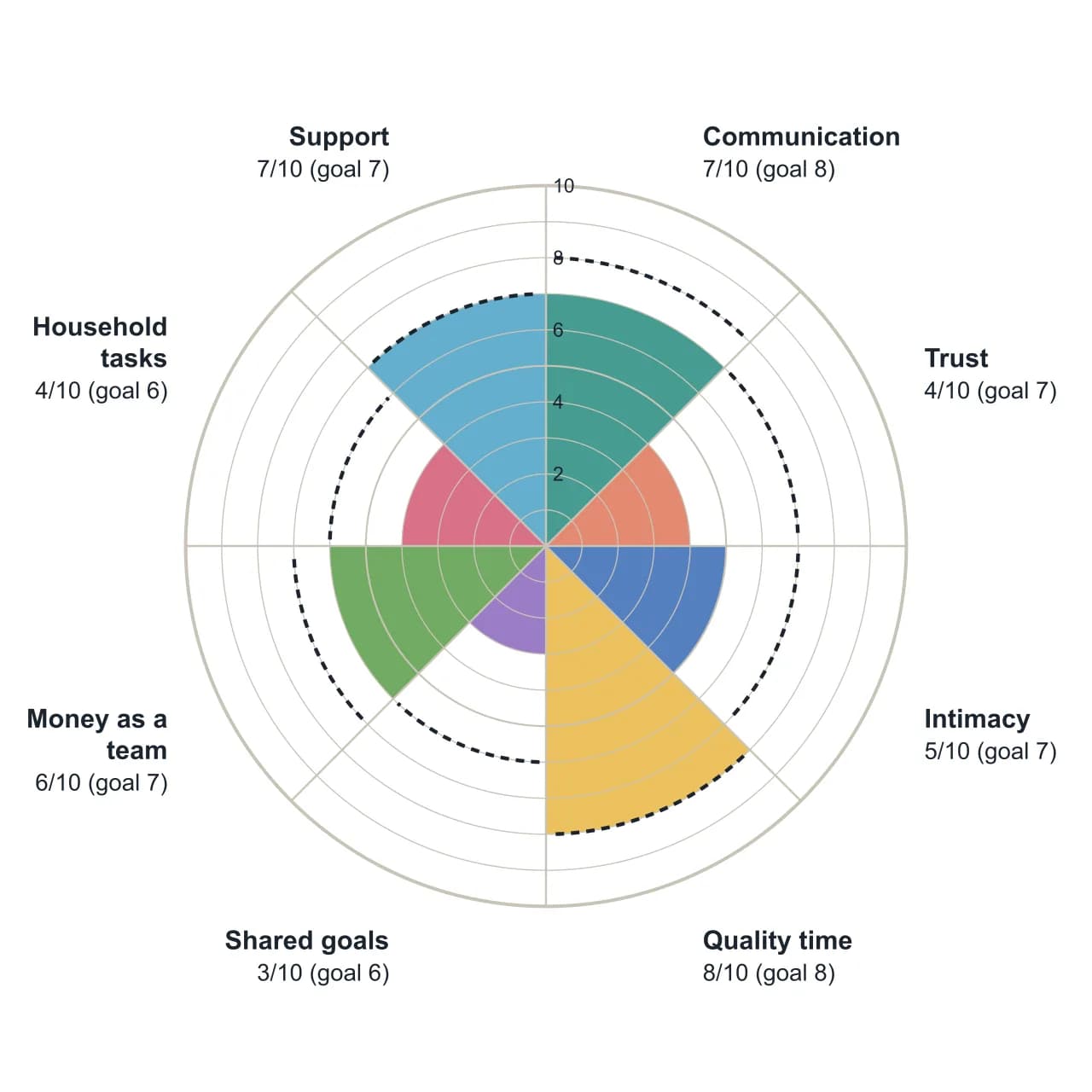
We scored a test wheel with this exact tool. Therefore, the chart, the numbers and the first plan step all come from the same run, so you can compare them with your own result.
- Test input
- Relationship wheel: Communication 7, Trust 4, Intimacy 5, Quality time 8, Shared goals 3, Money as a team 6, Household tasks 4, Support 7
- Output
- Wheel chart, balance score and a one week plan
- Balance score
- 63 of 100
- Average
- 5.5
- Lowest area
- Shared goals (3)
- Plan focus
- Shared goals, Trust, Household tasks
- First step
- Choose one book, course or podcast series on a topic you care about and give it 20 minutes three times this week.
- Output size
- 60 KB
- Processing time
- 1 ms
How we test: every page scores its own area set with the same fixed test scores, and we check each wheel by hand. More on the about page.
The eight areas of the relationship wheel
Communication, trust and intimacy form the core of the wheel. Quality time asks if you spend time together that is not about chores or screens. Shared goals covers plans such as where to live, children or career moves.
The last three areas are practical. Money as a team asks how well you plan and talk about money. Household tasks is about who does what at home, while support asks if you feel backed up when life gets hard. You can rename any area, for example Household tasks to Parenting.
Filling in the wheel alone or together
Alone, the relationship wheel is a quiet way to sort your own feelings before a big talk. It can show that the problem you feel is really one or two areas, not the whole relationship.
Together, it works best when each partner scores in private first. Then compare. Two wheels with the same shape mean you see things the same way, even if the scores are low. In contrast, very different shapes are the real signal, because they mean you are living the same relationship in different ways.
Talking about the gaps calmly
Choose a quiet time, not the end of a long day. Start with an area where you both scored well, so the talk begins on good ground. Then move to one gap and ask your partner what their score means to them.
Use "I" sentences, such as "I feel alone when plans change last minute." Also avoid defending your own score while your partner explains theirs. Finally, agree on one small change for the week and look at the wheel again in a month.
When to see a couples counselor
The relationship wheel is a reflection exercise, not a clinical test. It cannot judge whether a relationship is healthy or safe.
If the same gap leads to the same fight every time, or if either of you feels afraid, talk to a licensed couples counselor. Even so, bringing both wheels to the first session can help, since it gives the counselor a quick picture of where each of you stands.
Relationship wheel at a glance
| Item | Detail |
|---|---|
| Areas | communication, trust, intimacy, quality time, shared goals, money as a team, household tasks, support |
| Scale | 1 to 10 per area, optional goal |
| Use | alone, or each partner separately and then compared |
| Time | about 3 minutes per person, plus the talk |
| Sharing | share link with scores in the URL, nothing stored on our server |
| Limits | reflection only, not a replacement for counseling |
Relationship wheel FAQ
What is a relationship wheel?
It is a version of the wheel of life for couples. You score eight parts of your partnership from 1 to 10 and look at the shape of the chart.
How do couples use the relationship wheel?
Each partner fills in a wheel alone, then you compare the two. The areas with the biggest difference are the best place to start talking.
Can I fill in a relationship wheel on my own?
Yes. Many people use it alone to get clear on what bothers them before they bring it up with their partner.
Is my relationship wheel private?
Yes. The scores stay in your browser and in the share link. We only store a wheel if you save it to your own account.
Is the relationship wheel the same as the power and control wheel?
No. The power and control wheel describes patterns of abuse. This tool is a satisfaction check for couples. If you feel unsafe, contact a domestic violence hotline or a counselor.
Can a couples counselor use this wheel?
Yes. The blank printable PDF works in sessions, and the Coach plan covers more action plans for client work.