Wheel of life exercise: a guide for solo, pairs and groups
The wheel of life exercise takes about 20 minutes: score eight life areas from 1 to 10, look at the shape, then answer a few reflection questions. You can run it alone, with a partner who asks the questions, or in a workshop where everyone scores in silence first and then talks.
By The Evenspoke team (Product and testing). Last updated .
- 5
- 5
- 5
- 5
- 5
- 5
- 5
- 5
- Balance
- 100/100
- Average
- 5
- Lowest
- Career (5)
- Spread
- 0
Turn the wheel into a one week plan
How to do the wheel of life exercise, step by step
- Set a timer for 20 minutes and find a quiet spot.
- Score each area on the wheel below in under five minutes.
- Look at the shape and name the flattest side out loud or on paper.
- Answer three reflection prompts about your lowest area.
- Pick one small step for this week and write it next to the wheel.
- Save or download the wheel so you can repeat the exercise next month.
The wheel, the PNG and the PDF are free with no limit. The first 3 action plans each day are free too. After that, see the pricing page for packs and plans, or read how we test the tool.
Wheel of life exercise tested with a real wheel
We scored a test wheel with this exact tool. Therefore, the chart, the numbers and the first plan step all come from the same run, so you can compare them with your own result.
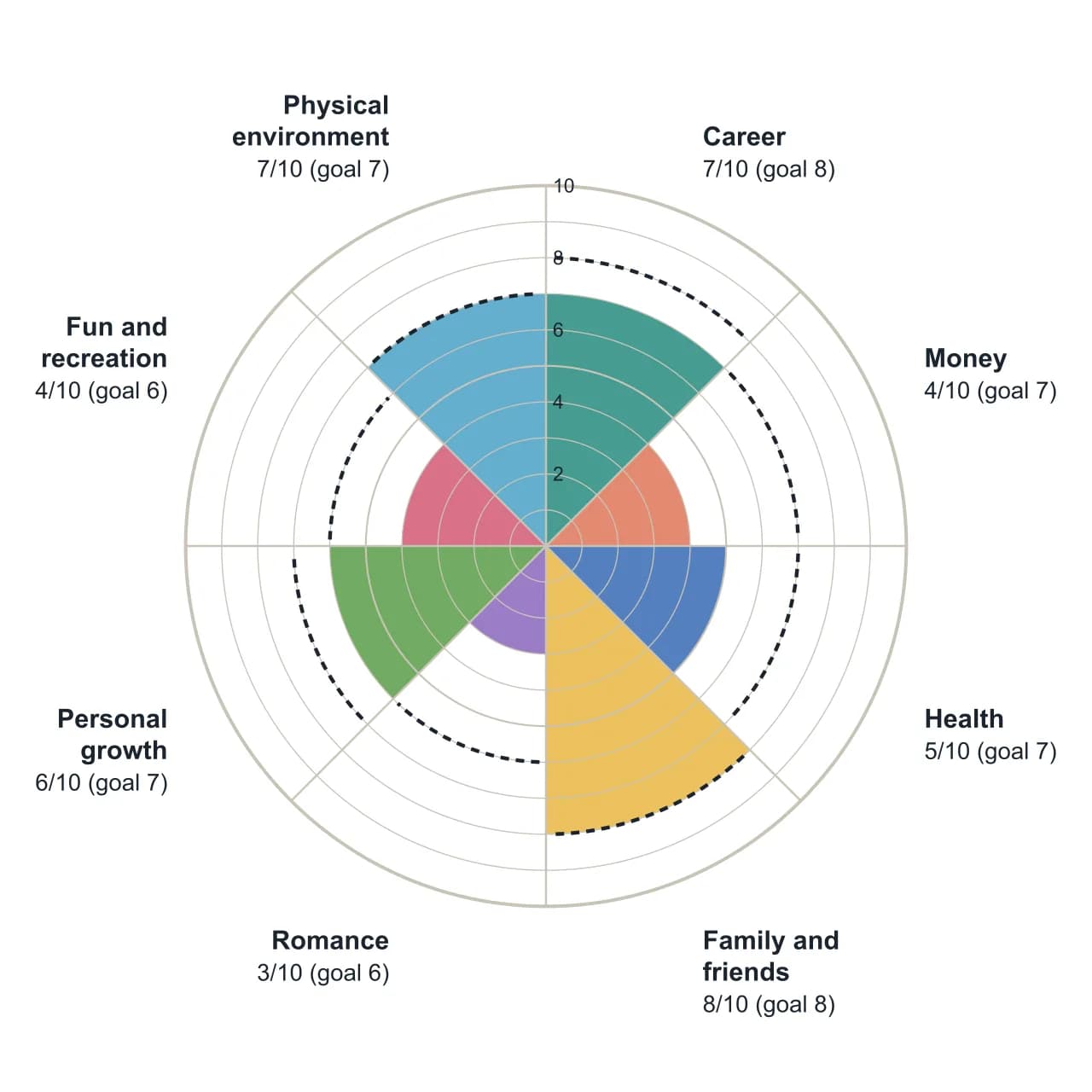
- Test input
- Classic 8 areas: Career 7, Money 4, Health 5, Family and friends 8, Romance 3, Personal growth 6, Fun and recreation 4, Physical environment 7
- Output
- Wheel chart, balance score and a one week plan
- Balance score
- 63 of 100
- Average
- 5.5
- Lowest area
- Romance (3)
- Plan focus
- Romance, Money, Fun and recreation
- First step
- If you have a partner, plan one hour this week with phones in another room. If you are single, write what you want in a partner and what you offer.
- Output size
- 61 KB
- Processing time
- 1 ms
How we test: every page scores its own area set with the same fixed test scores, and we check each wheel by hand. More on the about page.
Doing the wheel of life exercise on your own
Alone, the exercise works best in three short blocks. First, spend five minutes on scoring. Then spend five minutes just looking at the wheel. After that, use ten minutes for the reflection prompts further down this page.
Keep your phone away while you score. Also, try not to change a number once it is set. Your first answer is usually the honest one, and a second look tends to pull every score toward 6.
If you like paper, print a blank wheel and color each slice with a pen. Otherwise, the sliders here draw the chart for you, and you can save a PNG when you are done.
Running it with a partner or friend
With a partner, one person scores and the other only asks questions. The listener does not give advice. Instead, they ask things like "What makes this a 5 and not a 3?" and "What would a 7 look like?"
Swap roles after 15 minutes. As a result, each of you gets a full turn, and nobody drifts into comparing wheels. Couples can also share a link to their wheel, since the scores travel in the URL and nothing is stored on our server.
Using the exercise in a group workshop
In a workshop of 6 to 20 people, give everyone a printed wheel or this page on their phone. Then ask for ten silent minutes of scoring. Silence matters, because people copy the room when they score out loud.
Next, split the group into pairs for ten minutes of questions. Finally, bring everyone back and ask two or three volunteers to share one insight, not their scores. A full session fits into 45 minutes, including a short intro on how the scale works.
Reflection prompts after you score
The numbers are only half of the exercise. So pick your lowest area and answer these prompts in writing: What happened in this area over the last month? What would move it up by one point? What am I already doing that helps?
Then look at your highest area and ask what it costs you. For example, a 9 in career can explain a 4 in health. Finally, finish with one sentence that starts with "This week I will". Keep it small enough to do in 15 minutes.
Wheel of life exercise formats and timing
| Format | Time and setup |
|---|---|
| Alone | 20 minutes: 5 scoring, 5 looking, 10 reflecting |
| With a partner | 30 minutes: 15 per person, listener asks only questions |
| Group workshop | 45 minutes for 6 to 20 people, silent scoring first |
| Areas | 8 by default, 4 to 12 if you add or remove areas |
| Materials | this page or a blank printable PDF wheel |
| Repeat | once a month to see the trend |
Wheel of life exercise FAQ
How long does the wheel of life exercise take?
About 20 minutes on your own, 30 minutes with a partner and 45 minutes in a group workshop. Scoring alone takes under five minutes.
What questions should I ask after the wheel of life exercise?
Ask what happened in your lowest area this month, what would lift it by one point, and what your highest area costs you. Then write one small step for this week.
Can I do the wheel of life exercise with my partner?
Yes. Take turns: one person scores, the other asks open questions and gives no advice. Share your wheel with a link if you want to compare later.
How do I run a wheel of life workshop?
Start with a short intro to the scale, then ten minutes of silent scoring, ten minutes in pairs and a group round where people share one insight rather than their scores.
Is the wheel of life exercise a psychological test?
No. It is a reflection exercise, not a clinical or diagnostic test. If low scores come with a low mood that lasts, talk to a doctor or counselor.
How often should I repeat the exercise?
Once a month is enough for most people. A free account saves each wheel, so you can see how the shape changes over time.