Wellness wheel: score the 8 dimensions of wellness
A wellness wheel is a circle split into the eight dimensions of wellness: physical, emotional, intellectual, social, spiritual, occupational, financial and environmental. You rate each one from 1 to 10, and the chart shows which part of your well-being needs care first. The wheel below is ready to fill in now.
By The Evenspoke team (Product and testing). Last updated .
Download the blank wellness wheel (8 dimensions) template (PDF, US Letter)
- 5
- 5
- 5
- 5
- 5
- 5
- 5
- 5
- Balance
- 100/100
- Average
- 5
- Lowest
- Physical (5)
- Spread
- 0
Turn the wheel into a one week plan
How to fill in a wellness wheel, step by step
- Read the short meaning of each dimension below before you score it.
- Rate each of the eight dimensions from 1 to 10 for the past two weeks.
- Set a goal score for the one or two dimensions you most want to raise.
- Check the lowest dimension and ask which small habit would lift it.
- Download the PDF report or print the blank template for a group session.
The wheel, the PNG and the PDF are free with no limit. The first 3 action plans each day are free too. After that, see the pricing page for packs and plans, or read how we test the tool.
Wellness wheel tested with a real wheel
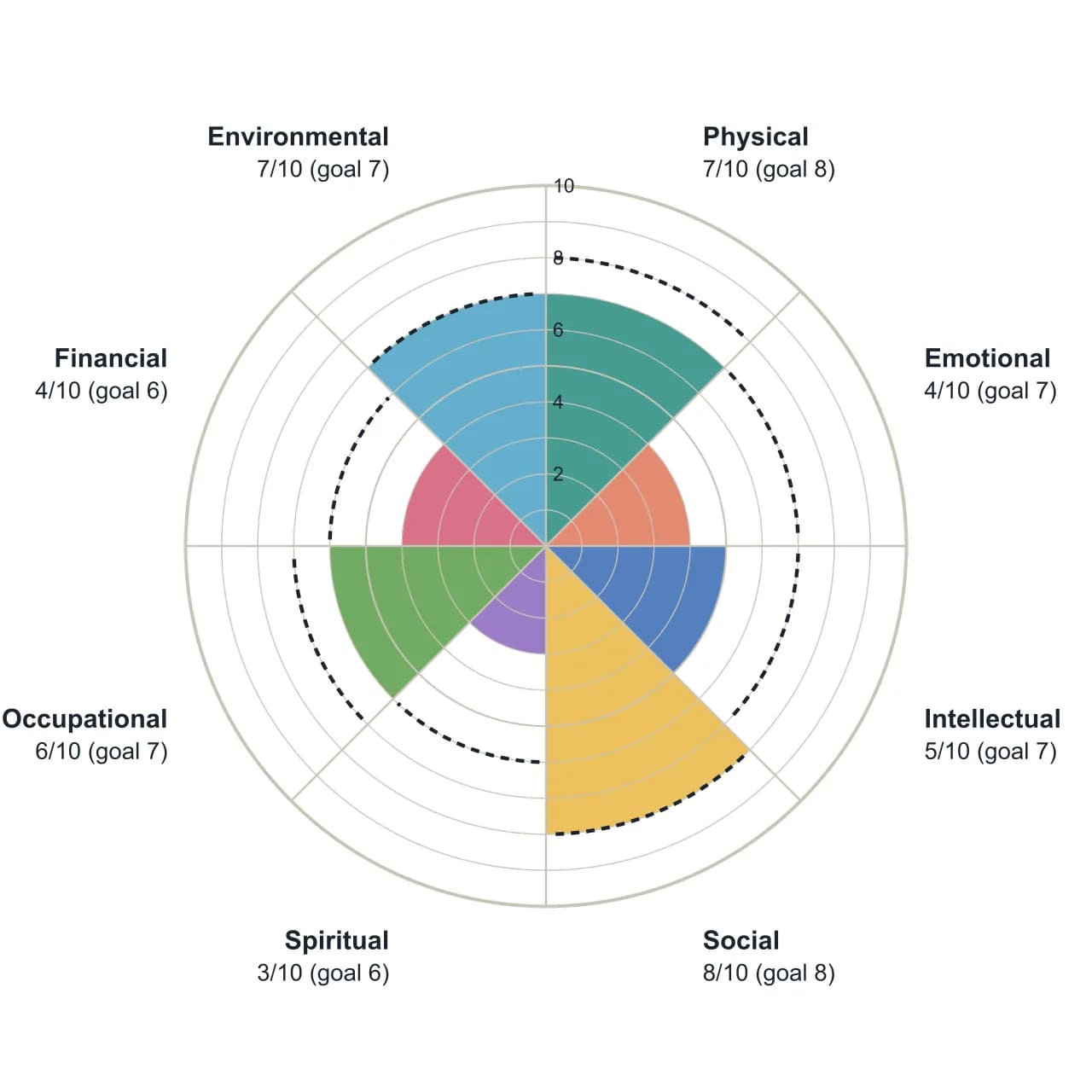
We scored a test wheel with this exact tool. Therefore, the chart, the numbers and the first plan step all come from the same run, so you can compare them with your own result.
- Test input
- Wellness wheel (8 dimensions): Physical 7, Emotional 4, Intellectual 5, Social 8, Spiritual 3, Occupational 6, Financial 4, Environmental 7
- Output
- Wheel chart, balance score and a one week plan
- Balance score
- 63 of 100
- Average
- 5.5
- Lowest area
- Spiritual (3)
- Plan focus
- Spiritual, Emotional, Financial
- First step
- Spend five quiet minutes each morning with no input: no phone, news or music.
- Output size
- 59 KB
- Processing time
- 1 ms
How we test: every page scores its own area set with the same fixed test scores, and we check each wheel by hand. More on the about page.
The 8 dimensions of the wellness wheel
First, physical covers sleep, food, movement and medical care. Emotional is how well you notice your feelings and handle them when they get strong. Intellectual means learning, curiosity and creative work, such as reading or a new skill. Next, social is the quality of your ties with friends, family and the wider community.
Spiritual is about purpose and values, and it does not have to mean religion. Occupational asks whether your work or study feels worth the effort. Financial covers money stress today as well as plans for later. Finally, environmental is your home, your street and the air, light and noise around you.
These eight dimensions come from the wellness model used by SAMHSA, the US agency for mental health and substance use programs. Because the list is public and simple, many groups adopted it as a shared language.
Where the wellness wheel is used
Schools and colleges use it in health class, orientation and residence life. A student fills in the wheel, then picks one dimension to work on for the term. Counselors also like it because it opens a talk without starting from a problem.
Similarly, HR teams and employee wellness programs use it as a check in before a benefits talk or a wellness challenge. In addition, clinics and peer support programs use it to plan recovery goals across more than one part of life. In each case, the wheel is a starting point for a conversation, not a score to report.
How it differs from the classic wheel of life
The classic wheel of life, made popular by Paul J. Meyer in the 1960s, is a goal setting tool. Its areas lean toward achievement: career, money, romance, fun and personal growth. By contrast, the wellness wheel is a health tool, so it gives separate slices to emotional, intellectual and spiritual health.
In practice, pick the wellness set when the goal is well-being or recovery. Pick the classic set when you plan a year or a career move. You can switch area sets above at any time, and your scores for matching areas stay in place.
Reading your results with care
Look at the lowest dimension first, then at the balance score. A balance score of 100 means all eight dimensions got the same number. For example, most people land well below that, which is normal.
Still, remember that this is a reflection exercise, not a medical or mental health test. If a low emotional or physical score has lasted for weeks, share the wheel with a doctor or counselor. That way, it gives them a quick picture of where things stand.
Wellness wheel at a glance
| Item | Detail |
|---|---|
| Dimensions | physical, emotional, intellectual, social, spiritual, occupational, financial, environmental |
| Scale | 1 to 10 per dimension, optional goal |
| Time | about 3 minutes |
| Common users | schools, colleges, HR teams, health and recovery programs |
| Printable | blank US Letter PDF with the eight dimensions |
| Cost | free, no account needed |
Wellness wheel FAQ
What are the 8 dimensions of the wellness wheel?
Physical, emotional, intellectual, social, spiritual, occupational, financial and environmental. The tool above opens with all eight, and you can rename or add areas.
Who created the wellness wheel?
Several wellness models grew in the US from the 1970s on. The eight dimension version on this page is the one SAMHSA uses in its wellness materials.
How do you use a wellness wheel in the classroom?
Hand out the blank PDF, give students five minutes to score each dimension, then ask each one to choose a single dimension and one small habit for the next two weeks. Nobody needs to share their scores.
Is the wellness wheel the same as the wheel of life?
Both use the same circle, so they look alike. However, the wheel of life focuses on life goals, while the wellness wheel focuses on health and well-being.
Can a wellness wheel diagnose a health problem?
No. It is a self reflection exercise. A doctor or licensed counselor should look at any low score that worries you.
Is there a printable wellness wheel PDF?
Yes. The printable link near the top of the page gives a free blank template with the eight dimensions, sized for US Letter paper.